


Introduction
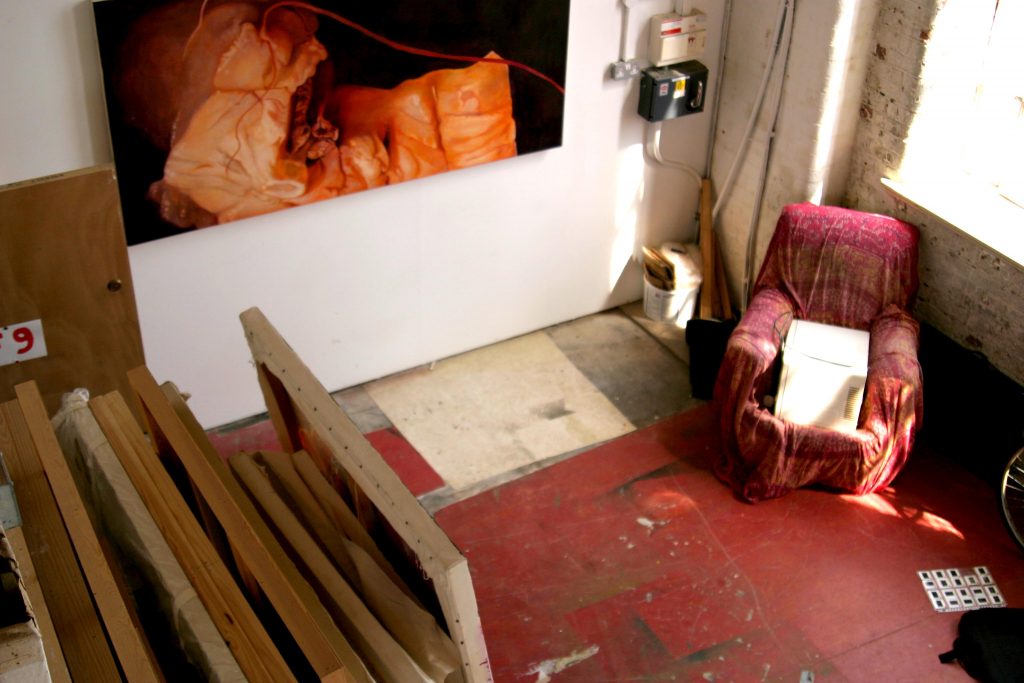
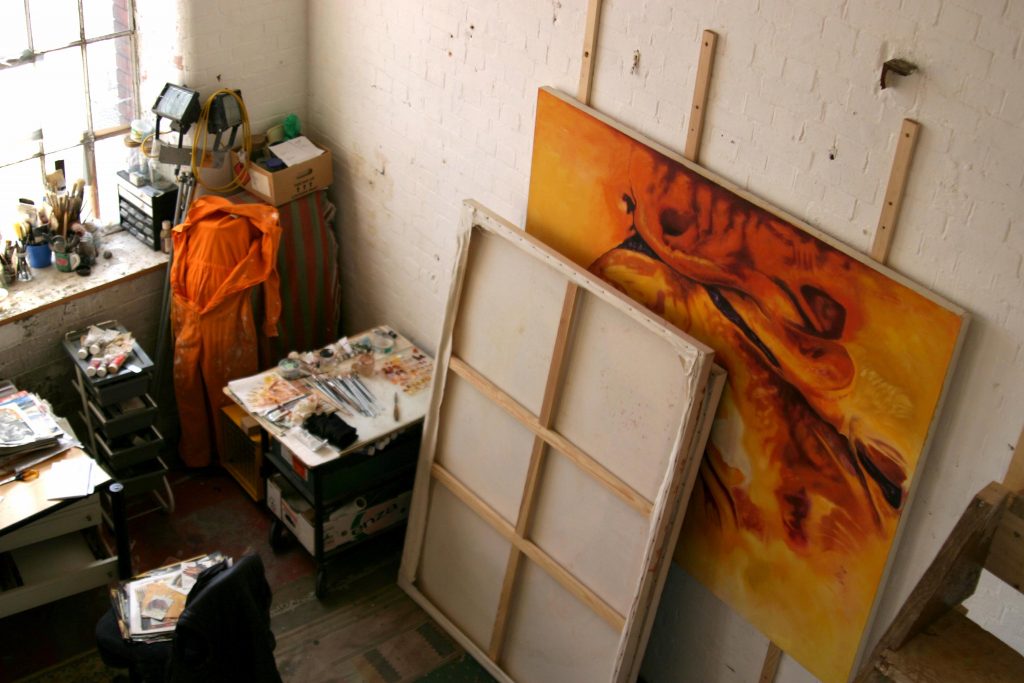
Embarrassingly personal confessions tend to pour from my mouth when I’m put on the spot and asked to discuss my work. This powerful, Freudian, impulse is as difficult to quell as an urgent need to defecate, and almost as satisfying. On reflection I have realised that whilst inappropriate in public, confession is as important to my practice as the work itself- it seeps silently into the fabric of my paintings. So be it.
There are many elements that generate and sustain an art practice. Some will be unmistakable, say, from the pursuit of knowledge; others will be less transparent and their significance not always logical or easily grasped. An abiding fascination with ugliness and grotesquery, and the assiduous collecting of cuttings and objects that somehow embody these qualities, clearly provide a foundation to my practice alongside my desire to capture and make still an image in paint.
My intention is to reveal the anatomy of my practice through examination of these and other disparate elements and their impact on my work. Comparing strengths and weaknesses I will also describe my working methods contextualising the work within current art discourse.
True Confessions
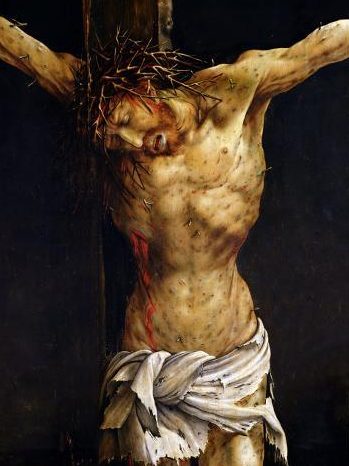
Details from the Crucifixion
Isenheimer Altar :: before 1516
I am resigned to the shameful fact that it was a revelation to me when I realised, after years of eye-tests, that the responsibility for obtaining the correct prescription for my lenses lay with me rather than with the optician’s infallible ability to prognosticate. Sadly, such misapprehensions are routine in my life. My contention is that a combination of implicit trust in ‘authority’ and a chronic lack of confidence in my own judgement make me endearingly obtuse. Others offer a different spin… the truth is I often seem impervious to the obvious. Embarking on the MA programme I found these traits coming to the fore and resolved to confront their manifestation in my practice.
Most problematic is my vulnerability to suggestion. Easily intimidated I have to resist accepting advice as gospel, and although harshly critical of my own work, can be reduced to inarticulate babbling (the confessions) in group crits, this despite having a sophisticated grasp of my own practice. It all started so well.
As a child, painting made me feel happy. I remember the pleasure of sleek, black metal tins containing blocks of watercolour, and contentedly sitting at a small easel. For my thirteenth birthday I received a set of oil paints, a gift that signified a deepening interest. Favourite artists at the time were Van Gogh, Bosch and the Bruegels but it was the work of Grunewald that I found most inspiring.
His paintings, in a library book reissued many times to me, were only in black and white, but through a teenager’s melodramatic gaze, they exerted a powerful fascination. Most impressive was the Isenheim altarpiece; its central theme, the crucifixion preoccupied me. Grunewald used diseased cadavers as inspiration for several of the bodies in his paintings including this one, so, no sanctimonious romanticised affair this, more “- a bitter dirge over one who was despised and rejected”. Against a brooding sky the Christ figure hangs from the cross, His limbs stark and distorted. The pallid skin is stretched over bones like an etiolated membrane, and strewn with tiny, bloody, festering wounds.
Eventually I had to steal the library book to indulge my morbid fascination and set about producing numerous, very bad, angst-ridden narrative paintings. That Easter I painted my own version of the crucifixion, albeit in a more glutinously sentimental style. I chose to paint it from the perspective of the cross, concentrating on the reactions of the family, watching. Considering this viewpoint in hindsight, I feel it might reveal an unconscious wish to display my own predicament, as helpless bystander, in the work.
I was a teenage victim
Ah, how stealthily the patterns of victimhood are instilled, the compulsion to please in order to placate, the cringing acceptance of guilt and the anguished empathy with fellow victims. I saw myself as being powerless – overly submissive, indecisive and in awe of any authority figure. As to the reason why, my dad was a bully and subsequent relationships repeated this model. Oblivious until psychotherapy in my forties, the habits are deeply ingrained and difficult to shrug off. Indeed there is some comfort to be gained from languishing in this little niche, where blame can always be passed to another’s door and it is clear to me that this identification has always fed into the work.
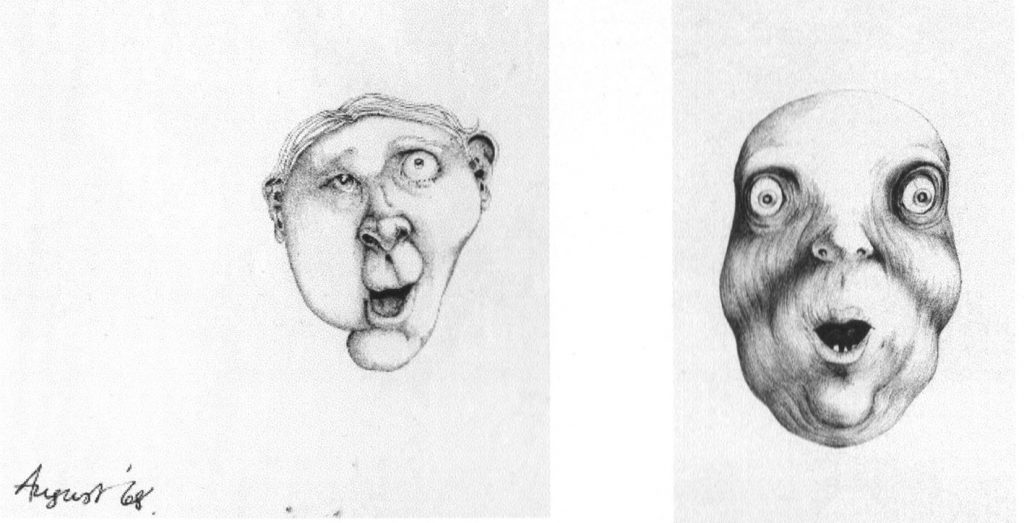
Things got ugly
This is most apparent in my fascination with dubious misfits, grotesquery and ugliness. In my late teens, recovering from depression, fetched up in the post-mortem department of the local hospital, typing PM reports. I had completed a Foundation in Art College but somehow lost my way. I began doodling in biro, between reports, and this developed into a series of drawings of increasingly distorted faces. The faces became more interesting and more bizarre as found that I could manipulate them, pull their features about and push them to the edge of perception. The wildly distorted and scabrous drawings of celebs and political figures by Ralph Steadman and Gerald Scarfe were a strong influence but I had no desire to satirize. For me the pleasure was feeling in control of what I was doing, they were my creations, and the more ugly and grotesque they became, the more affection and sympathy I felt.
One of my strongest impulses is to lay claim to what pleases me… Not exactly an acquisitive or avaricious urge, more a desire to hold still, to savour, and then to indicate and emphasise the qualities! perceive. I gloat but I want to communicate and share that pleasure, not hoard it away.
Cuttings
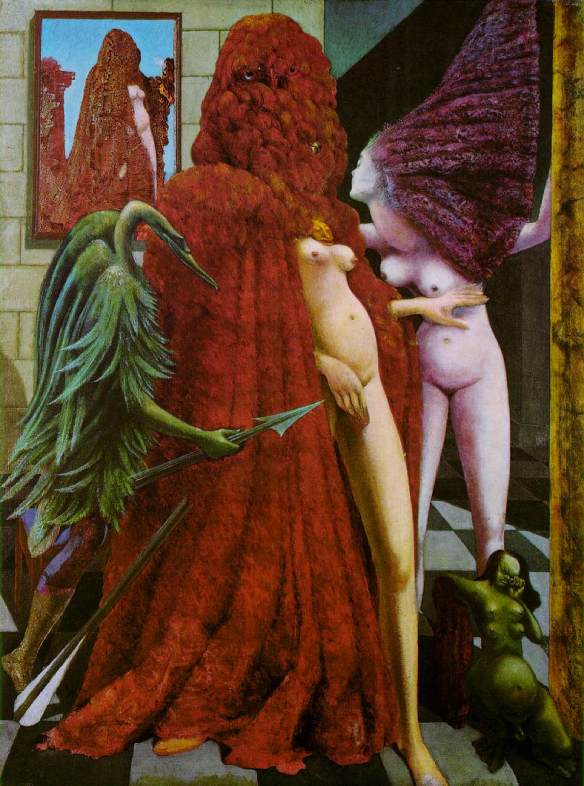
Attirement of the Bride :: 1940
oil on canvas, 129.6 x 96.3cm
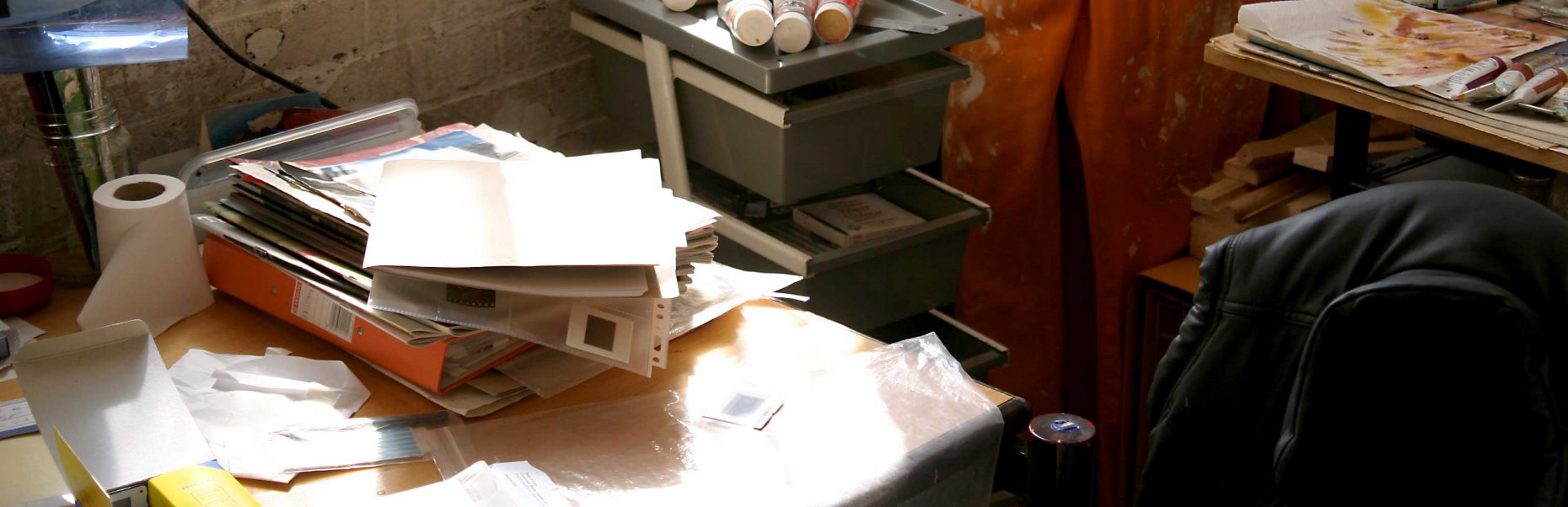
I possess an archive of thousands of cuttings, mainly photographs, carefully filed and sub-sectioned, which I began collecting around that same time. Gleaned from magazines and newspapers, I would save any photograph or article that caught my attention. It was a methodical and soothing activity that allowed me the illusion of a connection with reality whilst actually holding back the real world. Collecting is an essential part of my nature and leads me to save all sorts of things – books, films, abandoned toys, dead insects … mainly detritus, really… some would say clutter. I think it makes me feel more secure, and there is also a need to impress, or define myself to the world at large – “…this is who I am because I have such-and-such…” But more significantly, ‘to save’ can also mean ‘to rescue’, and it makes perfect sense to me that I am rescuing stuff. By liberating these items I redeem and elevate them into valved objects. I empathise with their obscurity and, I guess, unconsciously invite others to distinguish me by example.
In my paintings I attempt to communicate and share these concerns through use of particular images selected from my collection of cuttings – I consider it unnecessary to identify the precise nature of these images, in order to maintain ambiguity. Thus, over time, the meaning and purpose of the collection has intensified and the collecting process, once indiscriminate, has become focussed and dynamic. Acutely aware of precisely what I seek, I rip through sources, discarding tons of material, in order to harvest perhaps ten useful traces. To attract my attention these needs exist simply in a colour or cast, even a mere detail. The most exciting and intense for me are the ones I have judged as possessing a quality that I describe as ‘uncanny’.